In reply to singleslammer:
I too used to hate Lucas Prince of darkness.. however finding better isn't always easy.. Plus it leaves you vulnerable to issues when the replacement fails. Especially if you modified something to use the replacement..
My solution is to carry spares and the tools to replace. Why is it that Lucas parts when there is a spare in the trunk never seem to fail?

In reply to singleslammer:
You are right about the various issues that cause them to be junked.. However to be fair one really doesn't buy a heavy complex car for it's low operating cost.
I love the Jaguar V12 because the Rolls Royce V12 helped America win WW2. Those engines in P51's made mission after mission defending our bombers when America finally got involved. Even though the English were badly outnumbered they earlier defeated the Germans in the Battle of Brittan when no other country could.
Then they came to America as surplus and powered our boats in unlimited hydroplane racing for a few more decades and still appear in tractor pulling events. If our GI's could keep those engines reliable in the 1940's their children and grandchildren should be able to have fun with a Jaguar V12.
As for fuel mileage there were improvements.. The early one (1971-1980) was thirsty but then so was every other high performance engine of the era.. Jaguar made significant improvements with the advent of the H.E. in 1981 from maybe 12 MPG to sometimes over 17 mpg and by the time the 6.0 litre engine came out in 1993 they kept the same mileage or even slightly better over the 5.3

wspohn
HalfDork
4/25/15 4:06 p.m.
Trying to use an old Jag V-12 to produce power is one of the poorest ideas I've seen lately. While the engines are decently reliable in stock form, they don't put out that much, and when they do break, the cost of the rebuild means that you should literally park the car and walk away leaving the keys in it. There is no way to rebuild an old Jag V-12 for anything like what the car will be worth when it has been rebuilt. You are upside down, economically speaking, the minute you even think about it.
Turbo on a stock engine - another bad idea. If there is anything that will cause a weak older engine to break, it is throwing a turbo on it. The rings will go; you replace them and then the bottom end goes. Etc. And once you stick a turbo on them you are right back where they started where (with the stock mufflers) you can't tell whether it is a 12 cylinder or an 8, or a 6, or.....
BMW - same thing on the older ones from the 8 series - not much power. They were just under 300 bhp in stock form, had compromised porting and needed huge amounts of very expensive modification to substantially boost power. they sounded great in an 850, but no one in their right mind tried to mod them.
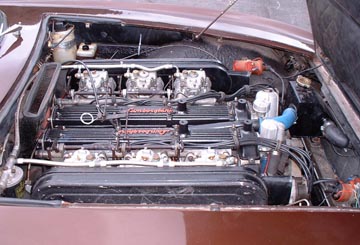
I love V-12s (pic of mine below - my 2 litre 4 cylinder puts out maybe 100 bhp more than it does, but doesn't sound as sweet), but they are the last thing anyone on a budget should consider.
Arent these things heavier than big blocks too?
Gives me a terrible idea that would piss everyone off. V12 jag in 60s gm product
chiodos wrote:
Arent these things heavier than big blocks too?
Gives me a terrible idea that would piss everyone off. V12 jag in 60s gm product
Guy that bought that 750il from me was going to put the V12 in some kind of variation of the 60's Suburban..
chiodos wrote:
Arent these things heavier than big blocks too?
A tick over 700lbs without a flywheel, ac compressor, ps pump or alternator
HEAVY beasts
In reply to wspohn:
If you want a lot of power cheaply, then buy a small block Chevy..However they are like a belly button, everybody's got one. Been there, done that,...next ?
The Jaguar V12 on the other hand can be purchased for less than small block Chevy prices and is insanely well built. The block looks like a top fuel block and the crank is even bigger than the one in that 5000 horsepower motor. The flaw with Jaguar's V12 is ham fisted, ignorant mechanics, or negligent owners.
Why a V12? because they are elegantly beautiful. Pull a V8, 6 or 4 from something. Strip off the ugly and there is nothing to admire or lust after..That all aluminum V12 engine is simply gorgeous. Imagine someone polishing one up. That would be the center piece in anyone's man cave..
While I've looked at a few open Ferrari V12's. The prices of parts would simply terrify me. Same with Aston Martin, BMW, or Mercedes Benz. However isn't that wonderful company to be in at prices Jag's sell for?!?
All of those engines have rare, expensive, transmissions behind them. Not the Jag V12 though.. after 1979 it was a turbo 400 or it's overdrive variant.. Yeh! something the guys at the transmission shop know how to fix and there are plenty cheap hot rod parts for.. But the really cool thing is the ease you can adapt an American 4-5 or 6 speed to the Jag V12. Not so with any other V12.
Power? 750 plus horsepower on carburetors has been done with reliability. Not to mention winning at LeMans. The 500 horsepower twin Turbo XJ-S I built from junk over 15 years ago for under $500 is still smoking tires without any problem. A couple of turbo's and intercoolers from Saabs plus a E Bay FMU for $65 is all it took. Wasn't pretty but cost less than the Chump Car $500 limit.
Why a V12? Ignore stock power and look at Torque! that little 326 cu. in. motor has more torque than big block V8's do that are 100+ cu in bigger.. Why? a V8 has a bad firing order. Adjacent cylinders may fire 90, 180 or 270degrees apart requiring headers to work. The Jag V12 fires 60 degrees apart.
Listen to the exhaust note of a V8. You really only hear 6 cylinders and a stumble.. However a V12 sounds like it's turning 1500 RPM at a 600rpm idle because you hear all 12 cylinders clearly.. That same even firing makes a V12 turbine like in it's smoothness..
In reply to chiodos:
The crank alone is massive and it does have 12 of everything instead of 6 or 8
On the other hand the Block, heads, valve covers, timing cover water pump, and almost everything is aluminum. Imagine polishing one up and putting it on display?
Wait, Top gear does that!!! They have a Jaguar V12 block with a Piece of glass on top as a coffee table..
In reply to Jumper K. Balls: about 30 ponds lighter than the earlier Jaguar 6 cylinder though
In reply to unevolved:
I've seen them in a Miata, Austin Healy and MGA's. There was a MGB V12 for autocross but an improperly fitted 5 speed ruined it.. (not the owners fault, the kit was not right and it ruined a good number of Jaguars)
If the chassis was designed for a 6 cylinder it will fit in easily and fit with width to spare anyplace a V8 fit's
This thread has me considering a v12 for my Galaxie. I'm sure that would go over well at the car shows 
Dammit now i want one to replace the junk straight eight in the packard
In reply to gearheadmb:
If you are swapping something into a Packard that isn't OE, I think that a Jag V12 is a much better choice than a tree-fiddy like everyone else.
frenchyd wrote:
In reply to unevolved:
I've seen them in a Miata, Austin Healy and MGA's. There was a MGB V12 for autocross but an improperly fitted 5 speed ruined it.. (not the owners fault, the kit was not right and it ruined a good number of Jaguars)
If the chassis was designed for a 6 cylinder it will fit in easily and fit with width to spare anyplace a V8 fit's
Can you elaborate on the Manual Transmission issues. I have looked at a few kits (that are really expensive) before and am always on the lookout for more information. Feel free to e-mail me if you aren't comfortable posting negative comments here.
Too many dollars to likely sell but I imagine that it is a fair bit less than those mods would cost to do yourself.
http://stlouis.craigslist.org/cto/4974216149.html

I wouldn't look at you funny at all, I've always thought one of those Jag v12 would be great in a seventies Lincoln continental. Those engine compartments are so big that a big block doesn't really look big. That engine would probably look right at home in a Galaxy
singleslammer wrote:
This thread has me considering a v12 for my Galaxie. I'm sure that would go over well at the car shows
In reply to singleslammer:
OOps! I hope I don't double post.
There seem to be a couple of V12 to T5 adaptors out there that shove the transmission hard to the crank. That eats up the thrust bearing and quickly starts to chew up the block. Result ruined motor..
It's easy to check and fix so don't junk a kit that you can buy cheap enough..
However you don't need to buy a kit to get the same benefit.. I'll assume you have or know someone with fabrication skills..
The early motors from 1971- to about 1978/79 used either a Borg Warner or Jaguar 4 speed.. While it is possible to adapt a T5 or other American 5-6 speed to those the work get's harder.. My suggestion is take the good bits off the earlier engine and swap them on the later block.. They will all fit, Just remember the early High flow Flathead can't use the H.E. pistons (unless you plan on converting the engine to Diesel ) but the earlier pistons will slide right in where the H.E. pistons lived.. only rarely have I found them not usable..
After that all V12's used the Turbo 400 transmission and those dowels also work on manual transmission bell housings from Chevy.. Just use a transfer punch to locate where to drill the bell housing for the Jaguar bolt pattern..
Use a V12 flywheel and the clutch disk needs to match the transmission's splines.. After that have a new driveshaft made and figure out how to mount the transmission.. {I mount mine rigidly because I race and the noise /vibrations don't matter in a race car}.
OK should you get a 5 or 6 speed? Remember 5th gear and 6th gear are both overdrives. If you have the 2:88 rear end ratio most Jaguars had after 1978 until 1992 you do it because of fuel mileage not because of performance.. The earliest ones had a 3:07 or a 3:31 final drive ratio and you can get a slight performance boost over a 4 speed. Later ones (1992 and later) had a 3:54 ratio so a 5 or 6 speed makes sense
In reply to HappyAndy:
What will you do with all the room at the sides? A V12 is only about 22 inches wide
In reply to gearheadmb:
Anybody wanna talk about cost effective engine mods on a V12? It really depends on what you are going to do with the engine.. If it's street most of the typical stuff won't work. Well Nitrous will give you an extra 150 horsepower if all you want to do is drag race for a few seconds..
Headers on a V12 for example make no real difference unlike V8's The reason is a V8 will have adjacent cylinders firing between 90/180, & 270 degrees where the Jaguar V12 fires every 60 degrees. Racing headers do make a difference but require 12 primary pipes 27 to 34 inches long depending on the duration of the camshaft.. That's a lot of pipe to stuff in a space where it's hard to get a finger in. That assumes they are proper headers and not simply tubular manifolds which is about the only thing I see for sale.
Jaguar's intakes flow 1200CFM so there is no real potential for improvement there.. Plus any changes to the Fuel injection means the ECU takes a trip to England.(to visit AJ6 engineering) It's not like Most American systems where you buy a "chip" and instant horsepower gain..
Yes you can mega squirt it or use other systems but then you have more skills and time than most people.. Plus that's not the secret to real power.
Webers are really expensive and to work properly you are talking chassis dyno time and a whole lot of parts cost. Plus every intake manifold I've seen is way too short to really work due to hood clearance issues..
You can turbo the early engines or use their low compression pistons on the later engines to make the system work without the need to buy the expensive racing fuel. Low dollar way is with used (but good) small turbo's from something like a SAAB. The trouble is getting them to fit is a real chore. Plan on doing a lot of body work.. The secret tip is you buy one of those FMU's that sense boost pressure and trick the computer into increasing fuel pressure.. Crude but workable. That will give you close to 200 extra horsepower.. On the one I built I mixed E85 with non oxygenated high test (collector cars , snow mobiles, and Boats use it around here) I was able to trim the fuel richness enough to keep everything working but I also used the advance curve from the H.E. instead of the early distributor.. Also the first V12's had the biggest injectors.
There are a lot of things possible if you intend to race and have a bigger budget. 750 horsepower is pretty well the standard but that requires a $20,000+ budget and some real knowledge..
You can kick the power up for peanuts though. The first horsepower increases costs pocket money but to get from 350 horsepower to 450 horsepower is going to cost at least a Grand.. and a fair amount of horse-trading skills..
frenchyd wrote:
In reply to HappyAndy:
What will you do with all the room at the sides? A V12 is only about 22 inches wide
I was thinking about installing a bench so I have somewhere to admire the motor from.
In reply to frenchyd:
Are you mguar?
Regardless, Thanks for joining us to be the jaaaaaag guy. I need one to feed my unholy lust of mid 90's xj6.
Dusterbd13 wrote:
In reply to frenchyd:
Are you mguar?
Regardless, Thanks for joining us to be the jaaaaaag guy. I need one to feed my unholy lust of mid 90's xj6.
I am not sure that is something that I would answer, if it were me.
In reply to Dusterbd13: So what can I tell you about Jag's?
Mind you I'm a racer so most issues people have with Jaguars I care very little about.. Power, handling, brakes, and other racing stuff is what I know about..

mancha
New Reader
4/27/15 8:29 p.m.
You guys kill me. I've always had a dream of putting a Jag v12 and IRS in my 68 Mustang. The Jag IRS would be the hard part. It'd be the classiest Mustang ever! That v12 weighs about the same as a Ford big block too.